INVESTIGATING REPRESENTATIONS AND CAUSES OF LINGUISTIC INSECURITY IN MÊRGESORÎ SPEECH COMMUNITY/ ERBIL
DOI:
https://doi.org/10.26436/hjuoz.2025.13.4.1629Keywords:
Linguistic Insecurity, Language shaming, Code-Switching, Linguistic PurismAbstract
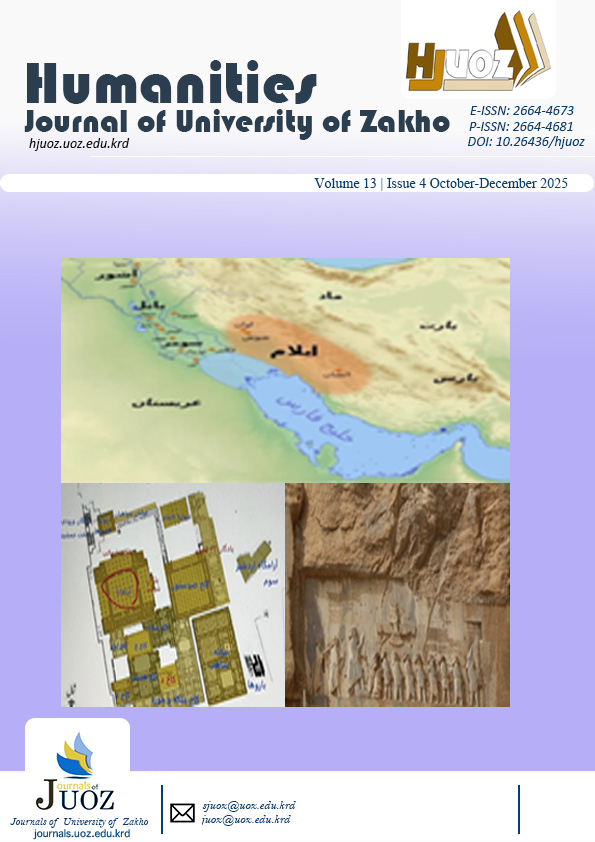
Linguistic insecurity as a mental and emotional construct can be realized in various forms. The current study deals with seven manifestations and causes of this sociolinguistic phenomenon in Mêrgesor District of the Kurdistan Region of Iraq. In the literature, no studies have examined linguistic insecurity as an intralinguistic phenomenon among the speakers of the Kurdish varieties in the region. Besides, the relatively small population in Mêrgesor District speaks a variety of Badînî subdialect, called Mêrgesorî, while it is dependent on the domineering Soranî subdialect for education and administration. Such imbalances and dependences can always shape language attitudes that control individuals’ linguistic behavior. The study employs a questionnaire and semi-structured interview as tools. The participants are 135 Mêrgesorî speakers and four language experts from the area. The findings of the study reveal that out of the seven linguistic insecurity forms only one is not found in the community. One of these forms, i.e., feeling guilty for code-switching, is an original manifestation that had no reference in the literature. The results also reveal that mostly the social factors, along the linguistic purism and essentialism ideologies, should be blamed for the persistence of linguistic insecurity in the community. The current study is important in the sense that it shows how language attitudes regulate the linguistic performance of Mêrgesorî speakers in different situations and domains. It also reinforces the previous studies over the existence of a diglossic situation in the Kurdistan Region of Iraq.
Downloads
References
Abtahian, Maya Ravindranath and Quinn, Connor McDonough (2017), “Language Shift and Linguistic Insecurity”, In Hildebrandt, Kristine A., Carmen Jany and Wilson Silva. (Eds.) Documenting Variation in Endangered Languages. Language Documentation and Conservation Special Publication (13), pp. 137-151, Honolulu: University of Hawai’I Press.
Bouchard, Marie-Eve (2023) “What is linguistic insecurity and why we should dismantle it”, [online article] Retrieved from: https://www.arts.ubc.ca/news/what-is-linguistic-insecurity-and-why-we-should-dismantle-it/#:~:text=This%20annoying%20feeling%20has%20a,%E2%80%9Ccorrect%E2%80%9D%20or%20more%20prestigious on April 10, 2025.
Bouchard, Marie-Eve (2024a) “Language ideologies and the use of French in an English-dominant context of Canda: New insights into linguistic insecurity”, Multilingua, Vol. 43(3), pp. 427–453.
Bouchard, Marie-Eve (2024b) “A youth perspective on the challenges related to fostering linguistic security in the classroom: New insights from the English-dominant context of British Columbia”, Canadian Journal of Applied Linguistics. Advanced Online Publication. Retrieved from: https://journals.lib.unb.ca/index.php/CJAL/libraryFiles/downloadPublic/79 , on April 10, 2025.
Calvet, Louis-Jean (2006) Towards an ecology of world languages, (Andrew Brown, Trans.) Cambridge: Polity Press. (Original work published in 1999).
Erbil Governorate Website https://www.hawlergov.org/app/ku/content/%D9%82%D9%87%E2%80%8C%D8%B2%D8%A7%DB%8C-%D9%85%DB%8E%D8%B1%DA%AF%D9%87%E2%80%8C%D8%B3%DB%86%D8%B1
Francard, Michel (1993), “Linguistic insecurity in the French Community of Belgium”, French and Society, No. (6) Brussels, Ministry of Culture, French Language Service, pp. 12-20.
Grenoble, Lenore A. and Whaley, Lindsay J. (1998) “Toward a typology of language endangerment”, in Endangered Languages: Language loss and community response, Lenore A. Grenoble and Lindsay J. Whaley (Eds.), Cambridge: Cambridge University Press, pp. 22-54.
Hassanpour, Amir, Sheyholislami, Jaffer and Skutnabb-Kangas, Tove, “Introduction. Kurdish: Linguicide, resistance and hope”, International Journal of the Sociology of Language, no.217, pp.1-18. Retrieved from https://doi.org/10.1515/ijsl-2012-0047 on June 25, 2025.
Hudson, R. (2001) Sociolinguistics (2nd ed), Cambridge: Cambridge University Press.
Labov, William. (1972) Sociolinguistic Patterns. Philadelphia: University of Pennsylvania Press.
Langer, Nils and Nesse, Agnete (2012) “Linguistic Purism” in The Handbook of Historical Sociolinguistics, Juan Manuel Hernández-Campoy and Juan Camilo Conde-Silvestre (Eds.) Malden: Blackwell Publishing Ltd, pp. 607-625.
Levasseur, Catherine, Bouchard, Marrie-Eve, and Ntiranyibagira, Canstantin (2023) “From linguistic insecurity to security: complexity and diversity of contexts”, OLBI Journal, Vol.13, pp.17-30.
Milroy, Lesley and Gordon, Mattew (2003) Sociolinguistics: Method and interpretation, Malden, MA: Blackwell Publishing.
Ogunniyi, Okedigba Segun, Abiodun, Omowon Aderonke and ‘Dapo, Adelowo Abimbola (2023) “Impact of linguistic insecurity on the English oral productivity of students of selected colleges of education in south-western Nigeria”, International Journal of Linguistics, Vol.4(3), pp.40-53.
Piller, Ingrid (2017) “Explorations in language shaming” Retrieved from: https://www.languageonthemove.com/explorations-in-language-shaming/ on April 11, 2025.
Rasheed, Minwas Jamal (2021) “Diglossia: A mixed method survey analysis on the use of formal and informal speech among Sorani Kurdish speakers”, International Journal of Social Sciences and Educational Studies, Vol.8(3), pp.249-268.
Saady, Dilovan Sayfuddin (2009) Diglossic situation in Hawler, PhD dissertation, University of Salahaddin, Erbil.
Tavakoli, Hossein (2012) A dictionary of research methodology and statistics in applied linguistics, Tehran: Rahnema.
Published
How to Cite
Issue
Section
License
Copyright (c) 2025 Leila H. Muhammad, Himdad A. Muhammad

This work is licensed under a Creative Commons Attribution-NonCommercial-ShareAlike 4.0 International License.
Authors who publish with this journal agree to the following terms:
- Authors retain copyright and grant the journal right of first publication with the work simultaneously licensed under a Creative Commons Attribution License [CC BY-NC-SA 4.0] that allows others to share the work with an acknowledgment of the work's authorship and initial publication in this journal.
- Authors are able to enter into separate, additional contractual arrangements for the non-exclusive distribution of the journal's published version of the work, with an acknowledgment of its initial publication in this journal.
- Authors are permitted and encouraged to post their work online.